
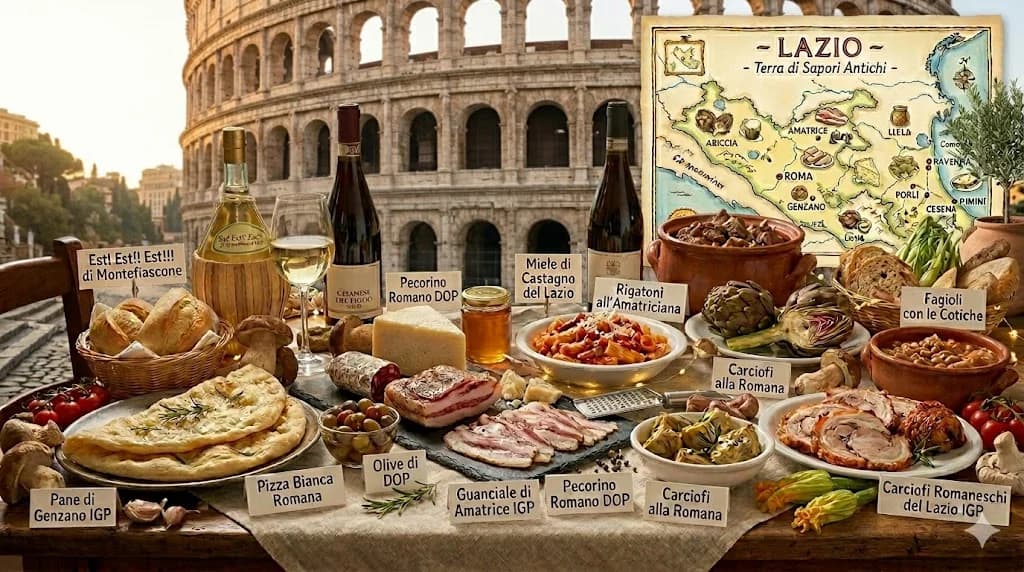
Lazio
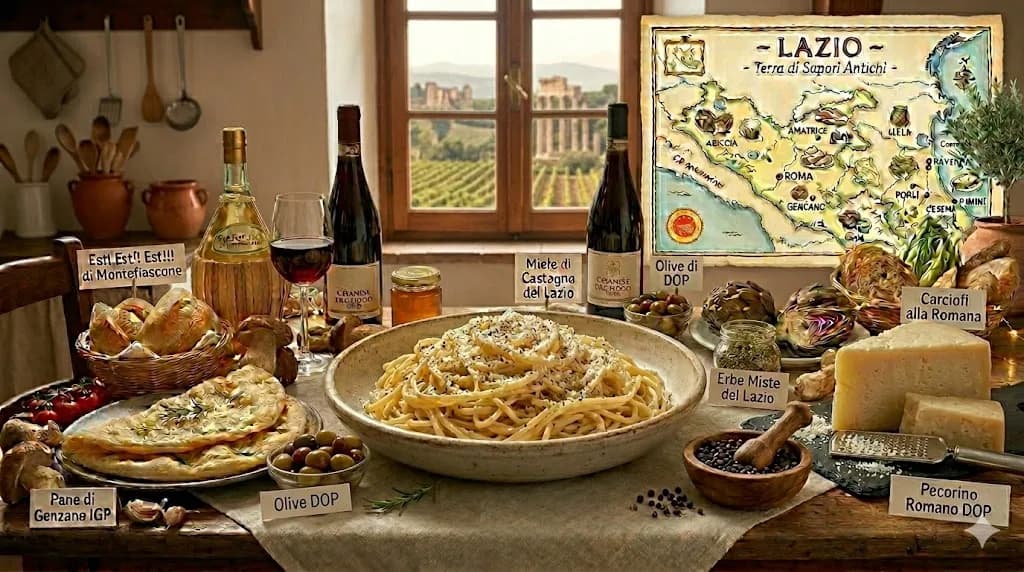
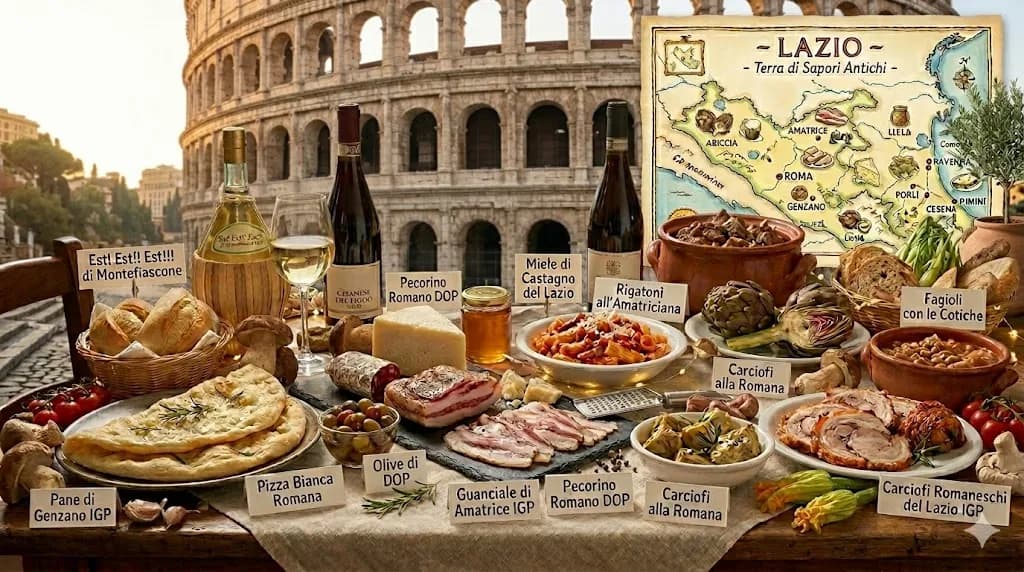
Lazio: Roman cuisine between popular identity, taverns and agricultural landscape
Lazio is one of the few Italian regions where cuisine is not limited to representing a territory, but coincides with a specific cultural idea: gastronomic Romanity. It is not just about recipes, but a language of taste born between taverns, markets, countryside and pastoral areas.
At the heart of it all is Rome, a city that has transformed popular cuisine into a global identity heritage. But Lazio is not only Rome: it is also the Roman Castles, the Ciociaria and the Amatrice Apennines, where the cuisine retains a more agricultural and pastoral dimension.
Here, food is never decoration: it is survival transformed into culture.
Lazio cuisine as a social language
Lazio cuisine is born from a condition s precise history: a large city, a productive countryside and a popular population that has always had to optimize resources.
For this reason, Lazio has developed one of the most coherent cuisines in Italy, based on a simple but radical principle:
maximum flavour with few essential ingredients.
It's not a strat kitchen aesthetic iffication, but of function transformed into identity.
Rome and the taverns: where the grammar of taste is born
Roman cuisine is not born in palaces, but in taverns, markets and public houses.
Here we define a gastronomic vocabulary that will become universal:
pecorino cheese as a sapid structure
cheek as an aromatic base
pepper as a technical element
pasta as the architecture of the dish
It is in this context that what we today call " Roman cuisine "was born, but which was originally simply everyday cuisine. bread>
The fifth quarter: the intelligence of necessity
One of the most distinctive elements of Lazio cuisine is the fifth quarter, or the use of offal and less noble cuts.
Coda alla vaccinara Tripe alla
romana
These dishes are not born as a gast choice ronomic, but as an economic necessity. However, over time, they have become very high expressions of technique and flavour.
Roman cuisine thus demonstrates a fundamental principle: what is born poor can become identity.
The three absolute icons: carbonara, amatriciana, cheese and pepper
If there is a universal code of contemporary Lazio cuisine, it can be summarized as three plates.
Carbonara: the modernity of tradition
Carbonara Carbonara
is not just a recipe: it is a technical construction based on the emulsion between egg, pecorino cheese and cheek fat.
It is the point where Roman cuisine becomes a global language.
Amatriciana: the identity of the territory
Amatriciana
Originally from Amatrice, it represents the bridge between pastoral cuisine and Roman cuisine.
Tomato, pillow and pecorino cheese become a perfect synthesis of territory and technique.
Cacio and pepper: the absolute essence
Cacio and pepper
Only two ingredients, but a precise technique.
It is probably the dish that most expresses the Roman idea of cooking: subtract until you find the balance.
The products: a kitchen built on a few pillars
The cuisine of Lazio is based on a very clear agricultural and pastoral base.
Pecorino Romano PDO
It is the identity cheese of Roman cuisine: savoury, decisive
, structuring.
Romanesque Artichoke of Lazio PGI
Symbol of Roman seasonal cuisine, it represents the vegetable part of a strongly carnivorous cuisine.
Added to these are:
seasoned pillow
Castelli Romani oil
point elle alla romana
The cuisine of the Castles and the countryside: non-urban Lazio
Outside of Rome, Lazio changes pace.
In the Castelli Romani the cuisine is linked to:
wine
porchetta
oil
hill farming
Porchetta becomes the symbol of a festive and rural gastronomic culture, deeply rooted in the territories.
Amateur and mountain cuisine
In the Amatrice area, the cuisine takes on a different character: more essential, the dedicated to pastoralism and conservation.
This is where one of the most important dishes of the Italian tradition is born:
amatriciana
sheep cheeses
cured meats
transhumance cuisine
It is the most rural Lazio, far from the capital but fundamental to its identity.
Wines from Lazio: a rediscovered tradition
Lazio viticulture has an ancient history, linked above all to the hilly territories.
Frascati Doc
It is the white wine of Castelli Romani: fresh, immediate, historically linked to Roman life
na.
Cesanese del Piglio DOCG
Structured red wine from the southern part of the region, an expression of Ciociaria.
Food as an urban ritual
In Rome, food is never just nutrition: it is social ritual.
Historic taverns are not just restaurants, but places of transmation cultural sion. Here the cuisine is consolidated as:
popular language
city identity
collective memory
Every Roman dish comes from a specific social context and keeps it alive over time.
How do you really read the kitchen of the Lazio
Lazio is not interpreted through complexity, but through coherence.
Rome is technical and urban identity
the Roman Castles are agriculture and conviviality
Ciociaria is pastoral memory
Amateur is c mountain ucina
Together they form a continuous gastronomic system, where each element makes sense in the other.
Conclusion: Lazio cuisine as an Italian cultural code
Lazio cuisine is one of the most influential in the world not for its richness or complexity, but for its ability to transform the essential into identity.
From the carbonara to the tail to the vaccinara, from the Roman pecorino to the Roman artichoke, from the Roman Castles to Amatrice, Lazio tells a simple and powerful truth: great cuisine is not born from abundance, but from the coherence between territory, history and daily gesture.
It is a cuisine that does not try to be told. It is a kitchen that has simply become a language.