
For the Boreto
To accompany
Place the fish in a single layer, lightly salt and distribute the coarse ground black pepper over the entire surface.
Taste and adjust salt if necessary.
The quality of the final result depends almost entirely on the freshness of the fish. In a professional context, it is essential to work with strictly fresh fish of the day, possibly of lagoon or Adriatic origin: the meat must be firm, not yield to finger pressure and not present unpleasant odours.
The ideal saucepan is made of glazed terracotta, which distributes heat evenly and prevents the metal from reacting with the vinegar. Alternatively, a deep non-stick pan is fine. It is essential never to mix the fish during cooking so as not to flake it. The rotary movement of the saucepan is the only gesture allowed.
Vinegar should be added cold or at room temperature, never hot, to prevent the sudden change in temperature from ruining the structure of the meats. The amount of black pepper must be generous, even beyond the comfort threshold: it is an integral part of the character of the dish, not a simple spicing. Those who work in a brigade must take into account that fish of different sizes have different cooking times: insert the thickest ones first and add the thinnest halfway through cooking.
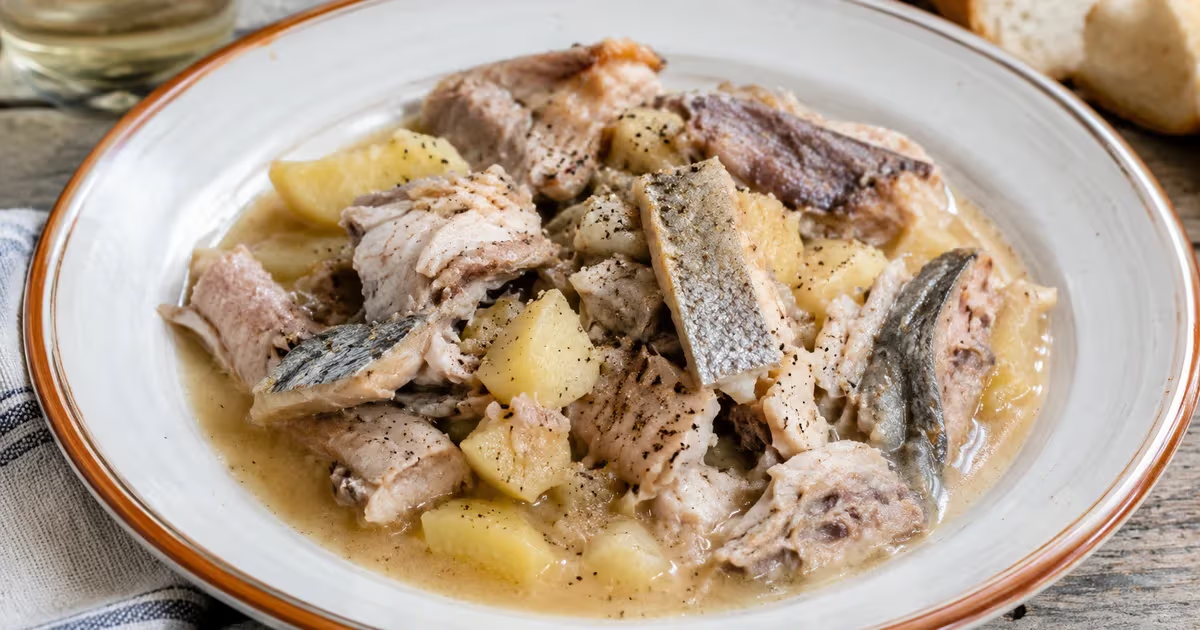
Boreto alla gradese is a typical fish stew from Grado, a small lagoon island in the Gulf of Trieste, overlooking the northern Adriatic.
It is an essential preparation, almost austere, which comes directly from the tradition of local fishermen: a dish designed to enhance the fish of less commercial value, what remained after the sale at the market, cooked on board the boats or in the houses of the ancient village with few ingredients available.
What distinguishes the boreto from any other Italian fish stew is the generous use of white wine vinegar and abundantly ground black pepper, which give the cooking bottom a pungent and decisive character. There are no tomatoes, no complex herbs, no elaborate stir-fry. Only garlic, oil, vinegar and pepper, to build a short and intense sauce around the fish.
The result is a dish with a clear flavour, with a certain roughness that tells its maritime origin without mediation.
Traditionally it is served with white polenta, which absorbs the cooking bottom and balances the acidity of the vinegar. In the lagoon it is still cooked with the same local fish varieties: sole, sparrows, lobsters, eels and other fish from the lagoon.
The boreto alla gradese knows some variations related to the habits of local families and the seasonal availability of the fish.
Boreto with eel: one of the oldest and most rustic versions, in which the lagoon eel is the unique protagonist. Cooking times are slightly longer due to the fatter and more compact meat. - **Boreto with only flat fish **: soles and floats without other fish, a more delicate and refined variant that can be found in the trattorias of the historic centre of Grado.
** White wine variant **: some families replace part of the vinegar with dry white wine, obtaining a less harsh and more aromatic base, although this is considered a concession to modernity compared to the original recipe.
** Triestine variant **: in Trieste there is a similar preparation called broth that includes the addition of onion and sometimes tomato preserves, moving away from the essentiality of gradese.
The acid and peppery profile of the boreto requires wines with a good acid structure and a discreet flavour, able to dialogue with the vinegar without overpowering the fish.
Friulano (Collio or Friuli Isonzo): the minerality and almond notes of this native vine are a classic and territorially consistent combination, able to withstand the acidity of the dish. - Malvasia istriana: aromatic white wine with a slight roundness that balances the pungency of black pepper and softens the acetic base.
Vitovska: Karst grape variety, with a saline character and great acid tension, perfect to accompany preparations of lagoon fish.
** Berliner Weisse craft beer **: its lactic acidity and alcoholic lightness represent an unconventional but surprisingly functional combination.
Store in a refrigerator at 2-4°C in an airtight container or covered with film, for up to 24 hours. - Do not freeze: the structure of the already cooked fish deteriorates irreparably with frost. - To regenerate, heat over low heat with lid by adding a tablespoon of water to prevent the bottom from drying out too much. Do not use the microwave.
The accompanying polenta is stored separately; once cooled it can be sliced and grilled or fried in a pan.
per serving
Grado is a city built on water, separated from the mainland and shaped for centuries by the lagoon that surrounds it. Boreto is the dish that this geography has generated: a food of necessity, born in the boats of Grateian fishermen when there was no other cuisine than live fire and the essential ingredients of everyday life.
The word boreto comes from the Venetian embroidery, brodetto, and reveals the long cultural overlap between the Serenissima and the Adriatic communities of the upper gulf. But while the broth has declined in dozens of versions along the Adriatic coast, the boreto gradese has maintained an almost obstinate fidelity to its original formula: poor fish, vinegar, black pepper, oil and garlic. Nothingelse.
During the twentieth century, with the increase in beach tourism in Grado, the dish became a symbol of identity for the local community, served in the taverns of the ancient village as a testimony to a way of life and eating rooted in the lagoon. Today it is protected among the traditional agri-food products of Friuli-Venezia Giulia.