
For the pasta
For the sauce
The success of pizzoccheri depends decisively on the quality of buckwheat flour: prefer stone-ground flour, preferably from Valtellina production, which preserves a more intense aromatic profile compared to refined industrial flours. The dough should not be elastic like wheat dough: it will be rougher and tend to crumble at the edges, which is normal.
In professional kitchens it is essential to organize the mise en place with the cheeses already sliced and the serving dish heated in the oven at 60-70 degrees before plating, because pizzoccheri must be layered and served within a few seconds: the residual heat is what melts the cheeses without overcooking them. The butter should be brought to brown butter without burning it, monitoring the temperature with a skimmer. Be careful not to drain the pasta too much: a small amount of cooking water favors tossing. Advise against tossing in a pan, which breaks the pizzoccheri.
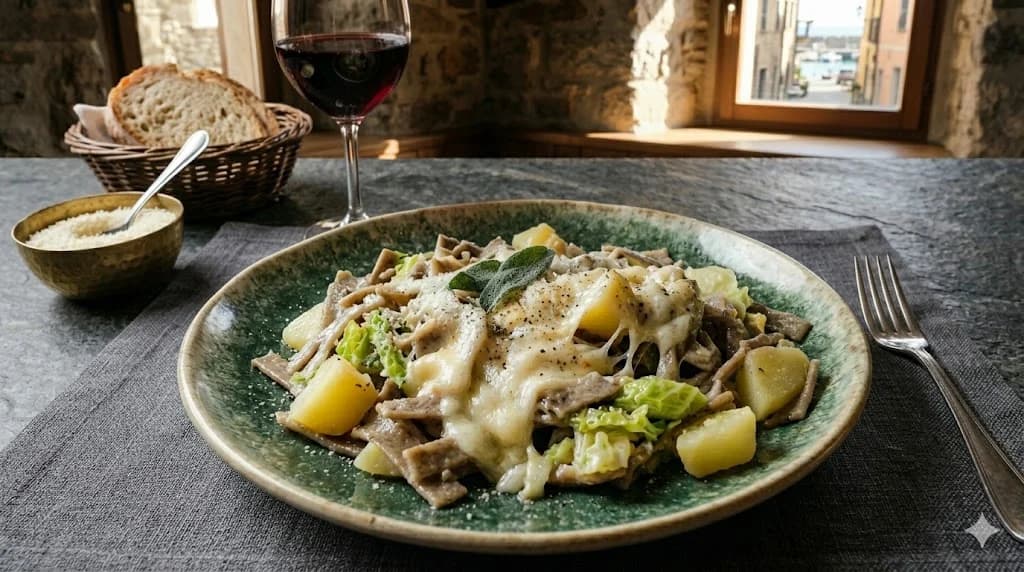
Pizzoccheri are a short pasta made from a dough of buckwheat flour and wheat flour, cut into strips about one centimeter wide and a few millimeters thick. They belong to the gastronomic tradition of Valtellina, the long Alpine valley that crosses the province of Sondrio from west to east, and in particular to the town of Teglio, which claims its historical paternity with a Pizzocchero Academy founded specifically to protect the original recipe.
In the traditional dish, the pasta is cooked together with winter vegetables, typically cabbage and potatoes, and seasoned with melted butter and Valtellina Casera DOP cheese, often accompanied by Bitto DOP. The result is a dense, enveloping dish, with the bitter and earthy note of buckwheat that dialogues with the savory quality of the cheeses and the sweetness of the potatoes. Pizzoccheri are historically the dish of the Valtelline mountain in the cold months, consumed in peasant families as a substantial meal after the labors of the fields or the stables. Today they appear regularly in the menus of valley trattorias and are prepared on the occasion of village festivals, family gatherings and during Carnival season, when tradition encourages their abundant consumption.
The recipe of the Pizzocchero Academy of Teglio defines with precision the proportions and ingredients, yet leaves room for some variations that have become established over time.
Pizzoccheri call for beverages with enough structure and acidity to balance the richness of butter and melted cheeses.
per serving
Teglio, a village of a thousand inhabitants clinging to the Rhaetian slope of Valtellina at over 800 metres above sea level, preserves the most documented memory of this dish. Buckwheat arrived in the alpine valleys between the 15th and 16th centuries, probably brought along the commercial routes that crossed the Rhaetian passes towards northern Europe. In a land where wheat struggled to mature due to climate and altitude, buckwheat represented a concrete response to the needs of a peasant and pastoral population: it grew quickly, resisted the cold and provided flour dense in calories.
Pizzoccheri entered the daily diet of mountain families as the meal par excellence of the winter months, when the pantry offered little more than aged cheeses, potatoes stored in the cellar and vegetables from the garden. Butter, abundant thanks to cattle farming, became the generous binder of the entire dish. In 1996 the Accademia del Pizzocchero of Teglio codified the original recipe, defining its ingredients and proportions with the aim of preserving its identity in the face of the numerous interpretations circulating outside of Valtellina.