
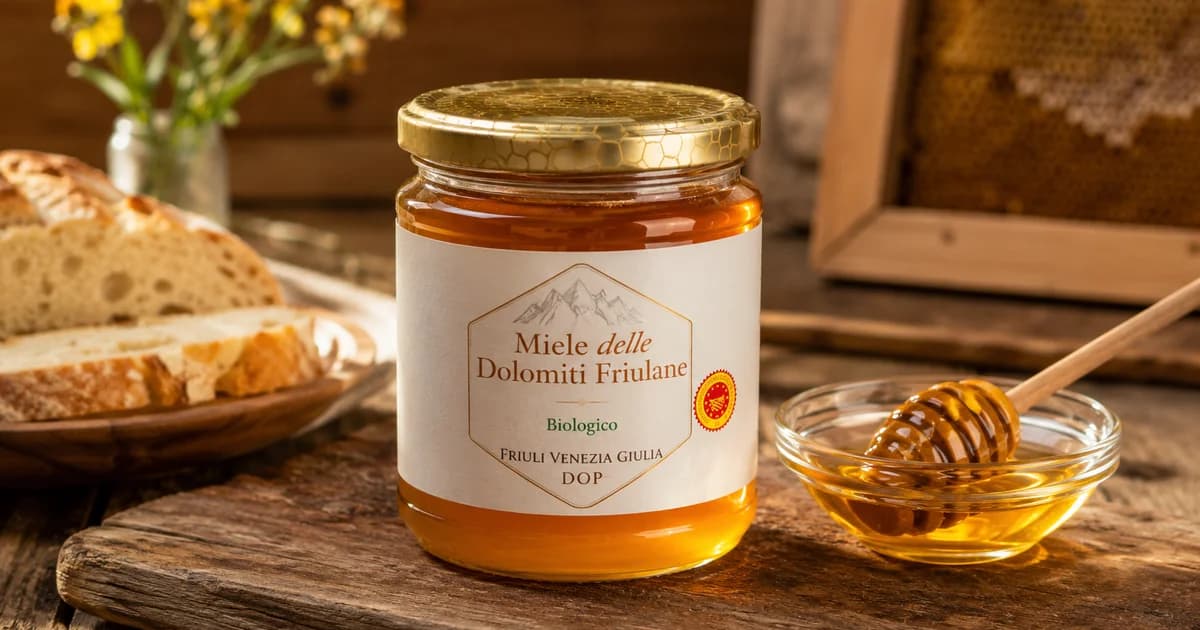
The Miele delle Dolomiti Friulane DOP is a mountain apicultural product obtained in the valleys of the Friuli Dolomites, a mountainous territory that occupies the western part of Friuli-Venezia Giulia, between the municipalities of Carnia and Pordenonese. The landscape of these valleys, rich in alpine meadows, coniferous forests, high-altitude pastures and unspoilt spontaneous flora, gives the honey well-defined and recognizable organoleptic characteristics. Depending on the botanical variety, it presents itself in forms ranging from pale yellow to dark brown in colour, with aromas that recall mountain flowers, resin, freshly cut grass or damp undergrowth. The consistency can be fluid or tending towards crystallization, according to the type.
In the kitchen, the Miele delle Dolomiti Friulane DOP lends itself to uses that are both simple and elaborate. It is traditionally paired with alp cheeses from the territory, fresh dairy products and rye bread. It also finds its place in typical Friulian sweet preparations, such as gubana and other leavened baked goods, or as a component of marinades and glazes for white meats and game.
The beekeeping tradition in the valleys of the Friuli Dolomites has deep roots in a mountain economy that, for centuries, integrated bee farming with pastoralism and forest management. Local communities knew and practiced apiculture already in medieval times, deriving from it not only a sweetening food but also wax for religious and domestic lighting. Honey harvesting was an integral part of the Alpine seasonal cycle, linked to swarm transhumance and vertical movements between valley floors and high-altitude mountain pastures.
During the twentieth century, the rationalization of beekeeping techniques and growing attention to territorial quality fostered the formal recognition of this product. Miele delle Dolomiti Friulane obtained Protected Designation of Origin status, a European recognition that binds production, harvesting, and packaging to a precise geographical area and to methods codified in the disciplinary regulations. The DOP trademark protects the characteristic varieties of the zone, including acacia honey, mountain wildflower honey, and chestnut honey, each a different and authentic expression of the Dolomitic floral heritage. The recognition strengthened the economic and cultural identity of local producers, contributing to valorize an otherwise marginal area from an agricultural standpoint.
The Honey of the Friuli Dolomites DOP is presented in distinct varieties, each with its own visual characteristics. The mountain wildflower honey generally has a color ranging from amber yellow to golden brown, with a tendency toward fine crystallization over time. Acacia honey is distinguished by its clear, almost transparent color and more lasting liquid consistency. Chestnut honey is recognizable by its dark tone and intense, almost pungent aroma, with a slightly bitter aftertaste.
To verify the authenticity of the product, it is essential to check for the presence of the DOP mark on the label, accompanied by the indication of the full denomination and the competent certification body. The regulations provide that packaging must take place in the area of origin. Products lacking these elements or with vague geographical indications cannot claim the denomination. An authentic mountain honey presents complex and well-defined fragrances, never standardized or neutral.
Honey is composed predominantly of simple sugars, particularly fructose and glucose, which make it a source of rapidly assimilable energy. It contains enzymes, organic acids, polyphenols, and traces of minerals such as potassium, calcium, and magnesium in varying amounts. Mountain varieties tend to have a higher content of antioxidants compared to plain honey, thanks to the floral richness of the collection area. The caloric content is approximately 300 kilocalories per 100 grams. It contains no fats or proteins in significant quantities.
Honey should be stored at room temperature, away from heat sources and direct light, preferably in well-sealed glass jars. It does not require refrigeration and, if stored correctly, maintains its organoleptic qualities for years. Crystallization is a natural process and does not indicate product deterioration. To return it to liquid state, it is sufficient to heat it in a bain-marie at low temperature, avoiding the microwave and high temperatures that alter the enzymes.
Miele delle Dolomiti Friulane DOP is predominantly consumed raw, to preserve its aromatic and enzymatic components intact. It is excellent spread on bread, rye bread or toasted polenta, but also finds expression as an ingredient in sweet or savoury preparations. The floral varieties lend themselves to accompanying fresh and aged mountain cheeses, while the chestnut honey, more robust, pairs with blue-veined cheeses and game preparations. In Alpine cuisine it is traditionally also used to flavour herbal teas, decoctions and hot winter beverages.
On the cheese front, acacia honey pairs elegantly with fresh cheeses and delicate dairy products from mountain pastures, while mountain wildflower honey accompanies aged cheeses like Montasio DOP in its more mature versions. Chestnut honey, with its bitter and persistent note, finds its ideal partner in blue cheeses and hard-paste cheeses with long aging.
For beverages, local traditions suggest pairing with aromatic white wines from Friuli, such as Ramato or Friulano, which balance the sweetness without overpowering it. With darker honey, pairing with amber-type craft beers or aged grappas typical of the Friuli mountain area also works well.
Gubana is the quintessential Friuli dessert in which honey plays a binding and flavoring role in the filling: a leavened dough wrapped around a mixture of walnuts, raisins, dried fruit and liqueur, sweetened with local honey. It is prepared for celebrations and family occasions.
Apple fritters with honey are a simple preparation rooted in Alpine home cooking: apple slices dipped in batter and fried, then drizzled with freshly harvested mountain honey, served warm as a winter dessert.
Friuli castagnaccio, a local variant of the chestnut flour dessert, sometimes includes chestnut honey in the batter or as a final garnish, emphasizing the aromatic correspondence between the bee product and that of the forest.
In the communities of the Friuli Dolomites, honey has always held a central place in domestic economy and seasonal food culture. Its harvest marked a precise moment in the rural calendar, linked to the end of the Alpine summer and the descent of the beehives from the mountain pastures. In many families, home honey production was passed down from generation to generation, and the jars preserved in the cellar represented a precious reserve for winter.
Even in its symbolic dimension, honey maintained a ritual significance: it was traditionally present at wedding banquets and tables of the most cherished religious celebrations, such as Christmas and Easter, often paired with the leavened sweets typical of the region. The connection between beekeeping and Friuli mountain identity remains alive in the generations of producers who today carry on this practice.
The Friuli Dolomites and the Carnia territory traditionally host seasonal markets and events dedicated to alpine pasture products and flavors, among which local honey is among the most anticipated presences. Among the initiatives linked to the enhancement of typical mountain products of Friuli-Venezia Giulia are autumn fairs in the villages of the Pordenone area and Carnia, where beekeeping producers present their varieties. The Friuli-Venezia Giulia Region furthermore supports agri-food promotion initiatives that include DOP products from the mountain territory.


