
Friuli Venezia Giulia
Friuli Venezia Giulia: complete gastronomic guide
food culture and regional identity
Introduction: a border region that becomes cuisine
Friuli Venezia Giulia is one of the most particular Italian regions from a gastronomic point of view. It is not just a territory, but a meeting point between cultures: Italian, Central European, Slovenian and Adriatic.
This geographical and historical complexity is directly reflected in the regional cuisine, which changes sharply between mountains, plains, hills and sea. The result is an essential but profound gastronomy, rural but refined, poor in its origins but very rich in expressions.
Friulian cuisine is not spectacular in the modern sense of the term: it is authentic, seasonal and linked to the daily life of villages, huts and taverns.
Identity of Friuli Venezia Giulia cuisine
Regional cuisine is based on some clearly recognisable key elements:
strong link with peasant and alpine culture
Central European and Balkan influence
use of simple, seasonal ingredients
large presence of fermentation and traditional preservation i
balance between sweet and savoury in many preparations
centrality of wine, cheeses, corn and pork
It is a cuisine that was born out of necessity, but has evolved into a complex and identity-based gastronomic heritage.
Typical products of Friuli Venezia Giulia
PDO, PGI, DOC and DOCG
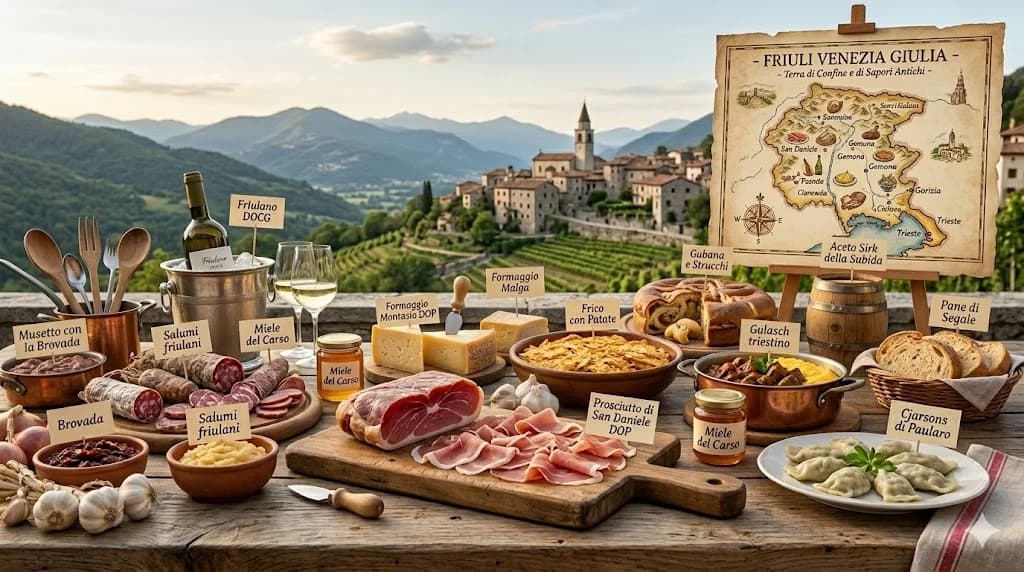
productsProsciutto di San Daniele PDO is one of the absolute excellences of Italian gastronomy. It stands out for its natural maturation, which takes place thanks to the meeting of alpine air and Adriatic humidity. The result is a sweet, aromatic and elegant ham.
Sauris Prosciutto PGI represents the tradition of Carnia. Its main feature is the smoke with beech wood, which gives it an intense and unmistakable aromatic profile.
Montasio PDO is the symbolic cheese of the region. Produced both in plains and in huts, it ranges from fresh to seasoned versions, with great versatility in the kitchen.
The Honey of the Friulian Dolomites PDO is born in the high mountains and reflects the Alpine floral biodiversity with complex and natural aromas.
The Collio Doc is one of the most important wine-growing areas in Italy, known for mineral, structured and long-lived white wines.
The Eastern Hills of Friuli Doc represent one of the richest areas of native vines, including Friulano, Ribolla Gialla, Sauvignon and Picolit.
Friuli Grave DOC produces more immediate and fresh wines, linked to the floodplain.
Ramandolo DOCG is a rare and precious sweet wine, made from Verduzzo grapes in the Nimis hills.
Picolit DOCG is one of the most prestigious and limited meditation wines in Italy.
The Schioppettino Doc is an elegant, spicy and distinctive native red.
Traditional PAT
productsFrico is the symbolic dish of the region. Prepared with Montasio and potatoes, it can be soft or crunchy and represents the synthesis of Friulian cuisine.
Brovada is an ancient preparation based on turnips fermented in pomace, with an acidic and complex taste.
Cjarsons are typical Carnian dumplings with sweet and savoury fillings that combine herbs, spices, ricotta and sometimes dried fruit.
Muset is a traditional cotechino often served with brovada, typical of the Friulian plain.
Plum dumplings represent a border tradition with Austro-Hungarian influences.
The jota triestina is a dense soup made from sauerkraut, beans and potatoes, a symbol of Trieste's cuisine.
Friulian goulash is a reinterpretation and local Central European dish, widespread especially in the Alpine areas.
Typical non-certified products
Malga cheeses are produced during the summer pasture with raw milk and represent one of the most authentic expressions of the Friulian mountain.
Friulian polenta is the historical basis of the regional diet, often accompanied by cheeses or stewed meats.
The mushrooms of the Pre-Alps and Carnia, in particular porcini and finferli, are the protagonists of autumn cuisine.
Local artisanal cured meats include salami, suppresses and bacon produced in small municipalities.
Apples from the Alpine valleys and the Friulian plain are a daily product are fundamental in the regional diet.
Traditional dishes of Friuli Venezia Giulia
Frico with potatoes or onion is one of the most representative dishes of the region and varies from family to family.
Carnic cjarsons express the complexity of mountain cuisine with a unique balance between sweet and savoury.
< span style="font-size: 12pt;"> Brovada and muset represent one of the oldest combinations of Friulian peasant tradition.
The Triestine jota is a symbol of the border cuisine between the Slavic, Austro-Hungarian and Italian worlds.
Polenta with malga cheeses is a central preparation of Alpine cuisine.
Plum dumplings tell the ’Austro-Hungarian historical influence.
Stewed game is typical of mountain and wooded areas.
Ancient legume and cereal soups represent traditional poor cuisine.
Friulian goulash shows its contamination with Central European cuisine.
The Adriatic fish characterizes the cuisine with of Trieste and Grado.
Typical wines and drinks
Friulano Doc is one of the most representative white wines in the region.
Ribolla Gialla Doc is an autochthonous vine of great freshness and structure.
Refosco dal Peduncolo Rosso Doc is an intense and territorial red wine. >
Malvasia Istriana Doc is widespread in coastal and karst areas.
Verduzzo Friulano is also used for traditional sweet wines.
The Schioppettino Doc is a spicy and refined red.
Ramandolo DOCG represents the excellence of sweet wines.
Il Picolit DOCG is one of the rarest and most prestigious wines in Italy.
Grappa friulana is a deeply rooted distilling tradition.
Karst DOC wines express a mineral and unique territory.
Gastronomic areas of Friuli Venezia Giulia
Carnia is the most mountainous area, with c based on malga cheeses, cjarsons, polenta and game.
Collio and Colli Orientali represent regional wine excellence.
The Friulian plain preserves the peasant cuisine based on brovada, muset and cured meats.
Trieste and Karst combine Central European, Adriatic and Slavic cuisine in a single gastronomic identity.
Traditions, festivals and gastronomic events
Friuli Venezia Giulia has one of the highest densities of local festivals in Italy.
Friuli Doc in Udine is the main regional food and wine event.
The San Daniele Ham Festival is one of the most important events at the national level.
The Sagra dei Osei di Sacile represents a deeply rooted historical tradition.
Brovada festivals in small municipalities keep peasant cuisine alive.
The harvest festivals in the Collio celebrate wine as an identity element.
The huts opened in Carnia enhance the production of casear and the Alps.
Widespread farmers' markets allow direct meetings between producers and consumers.
Gastronomic curiosities
Friulian cuisine is one of the most influenced by Central European culture in Italy.
The contrast between sweet and savoury is a recurring feature in many p traditional iatti.
Brovada is one of the few plant fermentations still alive in Italian cuisine.
Frico was born as a dish of recovery of the peasant tradition.
Wine is an integral part of everyday life and not only of the festive culture.
Tasting tips < /span>
Friulian cuisine is fully understood in the taverns of the small municipalities.
The wineries of Collio and Colli Orientali offer high-level tasting experiences.
The village festivals represent the most authentic context of the gastronomic tradition.
Seasonality is key to compren of local products.
Pro Loco is the main custodian of regional culinary culture.
Conclusion
Friuli Venezia Giulia represents one of the most complete and layered gastronomic identities in Italy. Its cuisine is born from the encounter between different cultures, territories and histories, but maintains a strong and recognisable coherence.
From the mountains of Carnia to the vineyards of Collio, from the agricultural plains to the Adriatic coast, each product tells a fragment of the territory and daily life.
It is a region that is not only visited, but understood through the food, the seasons and the roots that continue to live in its small municipalities.


