
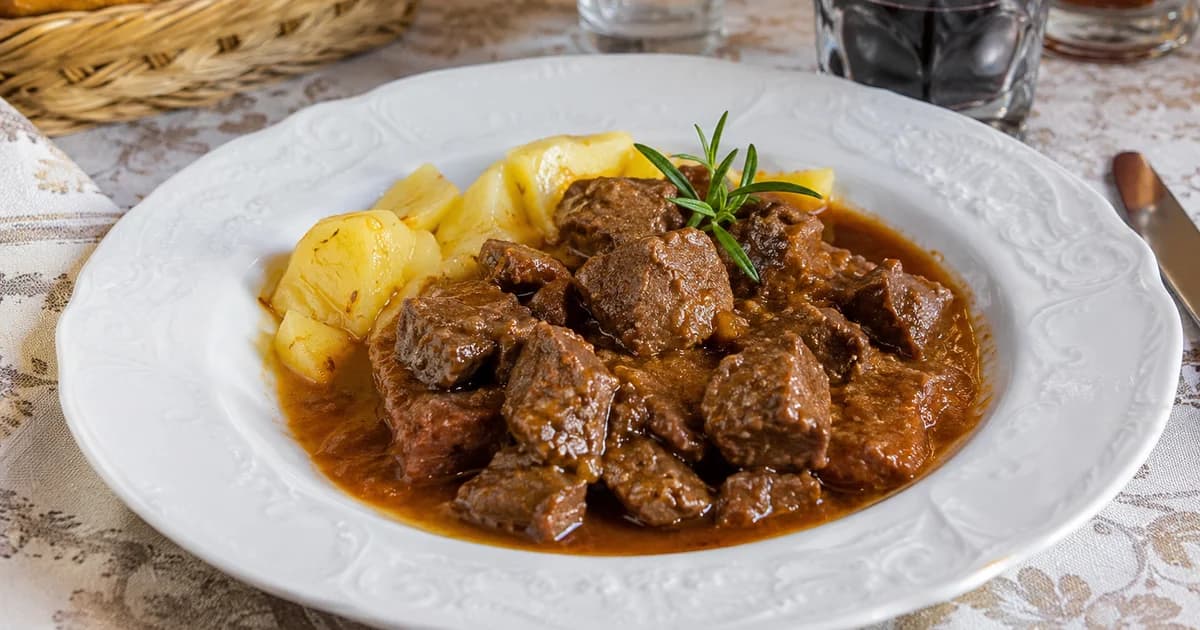
For the stew
To accompany
Add the chopped garlic and cumin seeds, brown for 1 minute.
Remove the saucepan from the heat, wait 30 seconds and combine the sweet and smoked paprika, stirring quickly so as not to burn them. 4. Put the saucepan back on the heat, add the tomato paste and stir for 1 minute. Combine the meat cubes and brown over high heat for 5-6 minutes, turning them on all sides. 5. Blend with the red wine and let the alcoholic part evaporate for 3-4 minutes.
Add the bay leaves and the hot broth, bring to a boil.
Prepare the polenta in the meantime: bring the salt water to a boil, pour the flour into the rain while stirring continuously and cook for the time indicated on the package (usually 40-50 minutes for traditional brewing).
The success of the Friulian goulash depends to a large extent on the onion: it must cook for a long time and over a sweet fire, until it almost melts in the fat, because it will give body and natural sweetness to the final sauce. Don't shorten this step.
Paprika should never be added over high heat: it burns in seconds and develops a bitter taste that compromises the entire dish. Always remove the saucepan from the heat before adding and stir quickly. Use quality paprika, preferably Hungarian or Spanish, in not too old packaging: the pigment and aroma decay quickly once opened.
For meat, choose cuts rich in collagen such as muscle, the priest's hat or the cheek: they melt in slow cooking and give jelly to the sauce, making it naturally thick without the need for thickeners. Do not brown the meat excessively before adding the liquids: in this stew the meat must not crust, but be mixed with the sautéed onion during cooking.
Friulian goulash is a slow-cooked beef stew, scented with paprika and cooked to a dense and enveloping sauce. It is the dish that best describes the border position of Friuli-Venezia Giulia, a land where Central European gastronomic culture has intertwined with that of Italy for centuries, leaving deep traces in the way of cooking and dining.
It is not the Hungarian gulyás in its original form, nor a simple imitation: it is a domesticated and rooted version, which in the trattorias of Trieste, Gorizia and the Friulian hinterland has found its own distinct identity.
It is a cold-season dish, traditionally served in the autumn and winter months, often accompanied by yellow polenta or firm canederli that absorb the thick, red sauce. The taste profile is intense and slightly pungent, with the sweet and smoky paprika dominating without covering the flavor of the meat, softened by a long cooking that makes it tender and juicy.
The red wine of the Karst or Collio that enters the preparation leaves a note of body and depth.
It is a shared dish, linked to the tavern and the conviviality at the end of the day.
The Friulian goulash knows some significant variants, mainly related to the geographical area and family use.
Triestine version: closer to the Habsburg tradition, it includes the addition of fresh or dried marjoram and sometimes a pinch of wine vinegar to balance the sweetness of the onion. It is often served with buckwheat bread or knödel.
Version with game: in some areas of the Friulian hinterland, especially in Carnia, beef is replaced by wild boar or deer, with even longer cooking and the addition of juniper berries and tannic red wine from Friuli Colli Orientali.
Pepper version: in some families, red peppers are added in cubes together with the onion, bringing the dish closer to the original Hungarian recipe and further softening the sauce. - White version: rare but present, without tomato concentrate and with meat broth in greater quantity, with a more delicate flavour and with paprika as the only dominant chromatic note.
The Friulian goulash, with its aromatic intensity and the fatness of the stew, calls for robust and characterful combinations.
Terrano del Karso: autochthonous tannic and acidic red wine, with a ferrous and earthy note, cuts the fatness of the stew and dialogues with the paprika in a harmonious way. - Refosco from the Red Peduncle of the Eastern Hills: softer than Terran, with ripe red fruits and a slightly bitter finish that cleans the palate between bites.
Collio Blauburgunder (Pinot Noir): for those who prefer a more elegant and less rustic combination, with silky tannins and aromas that do not overpower the spices of the dish.
Friulian pilsner type lager craft beer: the effervescence and bitterness of hops defat the palate and balance the sweetness of the onion in the sauce.
If advanced, it can be stored separately and reused grilled or fried the next day.
per serving
The history of goulash in Friuli-Venezia Giulia is inseparable from that of the Austro-Hungarian Empire. When Trieste was the main port of the Empire and Gorizia a cosmopolitan border city, the flows of people, goods and eating habits created a hybrid and vital cuisine.
The Hungarian gulyás, born as a dish of the herders of the Great Magyar Plain and then ennobled in the Viennese kitchens of the nineteenth century, arrived in the trattorias and houses of Friuli through the soldiers, officials and merchants who travelled the routes of the Empire.
In the transition from Central European to Friulian cuisine, the dish underwent significant adaptations: the lard took the place of the Hungarian lard, the local red wine entered the cooking, the corn polenta replaced the typical potatoes of the original version.
With the twentieth century and the passage of the region to Italy, the goulash remained in the repertoire of Trieste and Gorizia taverns as a tangible sign of a cultural heritage that the political border could not erase.
Even today, in the cold months, it is one of the most ordered dishes in the inland restaurants of Friuli.

