
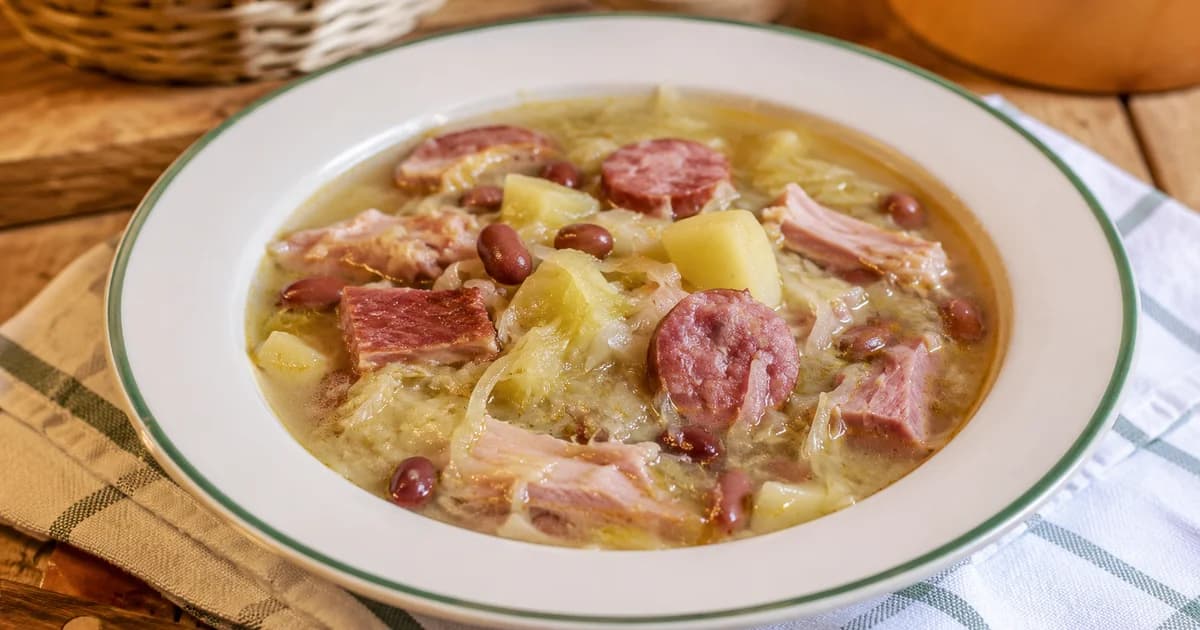
For the soup
The management of sauerkraut is the critical point. If they are very acidic, it's advisable to rinse them briefly under cold running water before adding them, but without eliminating too much of the fermentation: it is that acetic note that is the nerve of the dish. In a professional setting, the cooking water from beans, rich in starch, is often used to regulate density without resorting to flour, which can unnecessarily weigh it down.
The smoked ribs should be added cold with the broth to progressively extract collagen and fat: adding them hot would give a flatter result. The final roux should be prepared at low temperature to avoid burnt notes, which in a soup so structured would be difficult to mask. Jota requires resting: served immediately after cooking it is less balanced compared to the next day, when the components integrate. For restaurant service, preparing it the day before and regenerating it over low heat with a splash of additional broth guarantees optimal consistency and flavor.
Jota is the soup of the Trieste hinterland par excellence, a dish that carries inscribed in its fibers the historical complexity of a border city. Dense, robust, with a sour and smoky flavor that overlap in an unexpectedly harmonious way, it tells of the coexistence of Slavic, Austrian, and Italian cultures that shaped Trieste's taste for centuries. Its founding elements—beans, sauerkraut, potatoes, and cotechino or smoked pork ribs—are not simply ingredients: they are identity markers found with minimal variations from one side of the Karst to the other.
It is traditionally prepared in the cold months, when families consumed homemade sauerkraut and meats that had been aged in the autumn. It is not a dish for special occasions, but for winter everyday life, for long and convivial tables. The taste profile is decisive: the acidity of the sauerkraut balances the richness of the pork, the beans give body and density, garlic and bay leaf hold everything together with a fragrant note that emerges especially when left to rest. It is served with country bread or rye bread, and it is one of those dishes that improves noticeably the day after.
The jota has significant variations even within the scope of the Trieste Carso, and the differences reflect the seasonal availability of meats and family habits.
The jota needs beverages that can balance the acid-fat contrast without overpowering it.
per serving
In the taverns of the Carso that climb towards the Slovenian border, jota was already on the table long before anyone thought to write down its recipe. The term itself is traced back to Celtic or Vulgar Latin, through a linguistic path that well reflects the crossroads of peoples that has always characterized this north-eastern strip of the peninsula.
The recipe became established in a context of peasant and working-class cuisine, where sauerkraut fermented at home, dried beans and the remains of pigs slaughtered in autumn were the available resources to feed large families during winter. The Austrian occupation, which lasted until 1918, left precise traces in the use of sauerkraut and smoked meats, typical preservation practices of Central Europe that integrated with local traditions without ever completely erasing them. Jota was long considered poor man's food, then reappraised during the twentieth century as an identity gastronomic heritage of Trieste, a city that has always found in its table one of the most tenacious ways to assert its own cultural specificity.

